
100W Amplifier
This design uses the LM12CLK power operational amplifier as the main output device. The LM12CLK can drive very low impedances and deliver high output power up to 150 W into a 2 Ω load under ideal conditions. For safety and long-term stability this implementation is specified for 4 Ω loads, where a practical continuous RMS power of about 100 W is obtained.
Key specifications
Design and construction notes
Load choice: Although the LM12CLK is rated for operation into 2Ω, running the amplifier into a 4 Ω loudspeaker improves thermal margin, reduces stress on the IC, and increases reliability. The design target is ~100 W RMS into 4 Ω.
Output coil: The output L is a small snubber/inductance formed by 14 turns of #18 wire on a one-inch air core. Wind neatly and keep the coil close to the output terminal; ensure good insulation between turns and between coil and chassis.
Precision resistor: The 1.1 kΩ resistor should be a precision type (1% preferred) to stabilize bias/reference points. Mount it away from hot components to maintain tolerance.
Parallel output resistor: The resistor placed in parallel with the coil (as an output damping/load stabilization) must be rated for at least 2W. Use a metal-film or wirewound power resistor and provide airflow or a small heatsink if it runs warm.
Capacitors: All electrolytic capacitors in the power and coupling network should be rated at 50 V or preferably 63 V (choose voltage rating with respect to your supply rails and margin). Use low-ESR, audio-grade types where possible.
Thermal and safety recommendations
- Mount the LM12CLK on a substantial heatsink with thermal compound; the IC dissipates significant heat at high output levels.
- Provide adequate ventilation and consider a thermal cut-out or current limiting to protect the IC from thermal runaway or sustained clipping.
- Include a properly rated fuse on the main supply and observe correct polarity wiring for electrolytic capacitors.
- Lay out the PCB to keep high-current traces short and thick; separate the power stage from the small-signal sections to minimize oscillation risk.
Practical tips
| Item | Recommendation |
|---|---|
| Heatsinking | Large aluminium heatsink with thermal compound; consider forced air for sustained high power. |
| Decoupling | Place decoupling capacitors close to the IC supply pins (low ESR types). |
| Layout | Short power leads, star ground for supply returns, keep input traces away from output traces. |
| Testing | Start with limited input and monitor temperature and output waveform before full power tests. |
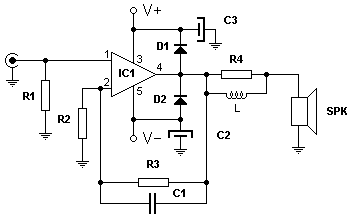
Power :
- V max: simetric +/- 24V DC
- I max: 5A
Components:
| Resistores | Capacitores | Semiconductors |
|---|---|---|
| R1 1 kΩ | C1 2.7 nF | D1 6A2 |
| R2 1.1 kΩ | C2 4700 µF | D2 6A2 |
| R3 3.3 kΩ | C3 4700 µF | IC1 LM12CLK |
| R4 2.2 Ω | SPK 4 Ω |