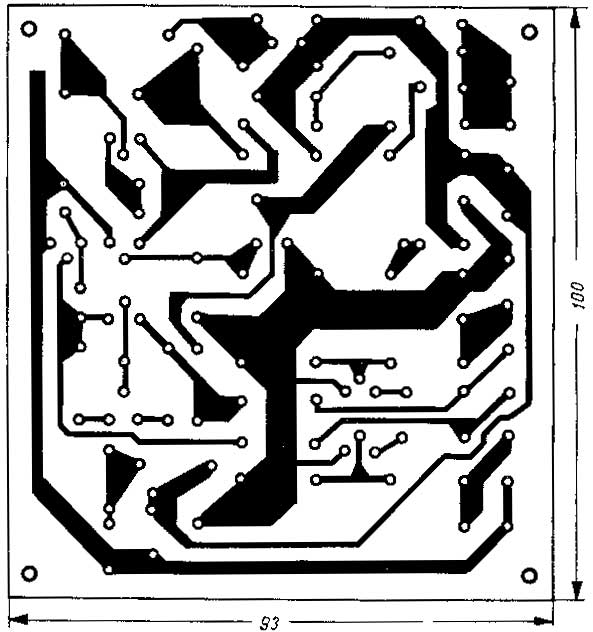
Audio Amplifier 100W
This audio amplifier uses a push-pull output stage with complementary power transistors: BDX66B (NPN) and BDX67B (PNP). It delivers clean, high-fidelity audio suitable for driving speakers at moderate power levels.
Power Supply
The amplifier requires a symmetrical ±40V DC supply. A suitable transformer is a 220V/110V to 30-0-30V AC unit, which is followed by rectification and filtering to obtain the ±40V DC rails. Proper filtering capacitors and a bridge rectifier ensure stable DC voltage for low distortion operation.
Schematic Overview
The circuit is composed of the following stages:
- Input stage: Differential or single-ended amplifier to accept audio signals.
- Driver stage: Provides sufficient current and voltage gain to drive the output transistors.
- Output stage: Complementary push-pull BDX66B/BDX67B transistors delivering the final amplified signal to the speaker.
- Power supply: Transformer 30-0-30V AC → bridge rectifier → smoothing capacitors → ±40V DC rails.
Construction Notes
- Mount BDX66B and BDX67B output transistors on a large heatsink with thermal paste to prevent overheating.
- Keep input signal traces away from high-current output paths to avoid oscillations.
- Use high-quality electrolytic capacitors rated at least 50V for filtering the power supply.
- Include fuses and proper wiring for safety when working with mains voltage.
- Ensure symmetrical layout for the ±40V rails to maintain balanced operation of the push-pull stage.
Note: The schematic above is a conceptual layout of the power supply. Ensure proper fusing and insulation when connecting to mains voltage.
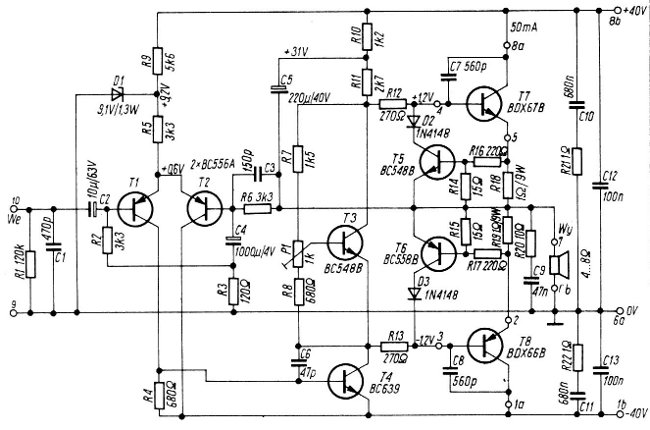
Power Supply Schematic diagram
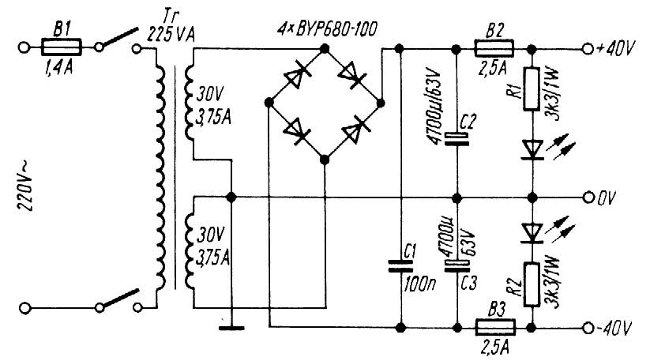
PCB Layout 1
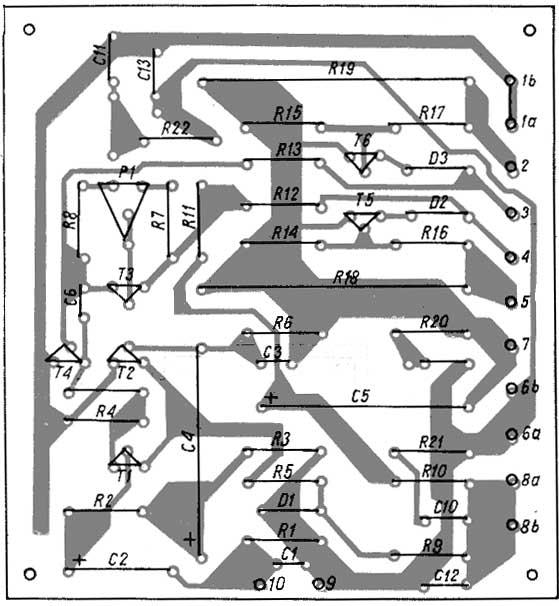
PCB Layout 2